Shamanic healing is an ancient, earth-based spiritual practice found in various forms across countless indigenous cultures worldwide. The etymology of the term traces back to the Tungusic word šaman, denoting a practitioner operating within the foundational paradigm of Animism—the perception that all materials, phenomena, and geographic features possess distinct spiritual essences. It is one of the oldest forms of healing on the planet. It operates on the principle that all physical, mental, and emotional ailments have a corresponding root cause in the spiritual realm. From a shamanic perspective, symptoms like depression, anxiety, or chronic illness are signs of a spiritual imbalance, a loss of power, or a disconnection from one’s soul.
While shamanic healing can offer several benefits, it should be approached with care and discernment. Practitioners and participants should be aware of shamanic healing safety concerns, such as potential psychological impacts and the importance of finding a qualified and trustworthy healer.
The Shamanic Worldview
To understand shamanic healing and its benefits, one must first understand its cosmology, popularized in the modern era by anthropological frameworks like Core Shamanism (synthesized by Michael Harner). Shamanism views reality as existing in multiple, interconnected layers, often referred to as the Three Worlds:
- The Lower World: An organic, earth-centric realm of instinctual intelligence and terrestrial connection. This domain houses totemic spirit guides, often manifesting as archetypal power animals, and serves as the primary locus for soul retrieval.
- The Middle World: The non-ordinary spiritual substrate of our immediate, objective physical reality. Healers navigate the energetic density of this realm to clear environmental or localized spiritual intrusions.
- The Upper World: An ethereal realm characterized by transcendent, formless frequencies. Practitioners journey here to interface with ascended energetic constructs, celestial teachers, and divine guidance.
The Role of the Shaman
The shamanic healer functions as a psychopomp and liminal intermediary—navigating the threshold between ordinary and non-ordinary reality. Crucially, they operate under the archetype of the wounded healer, having often survived an initiatory “shamanic illness” that forcefully dismantled their ego structure, granting them the psychic permeability required to channel transpersonal healing. They are the conduits, not the localized source, of the energetic resolution.
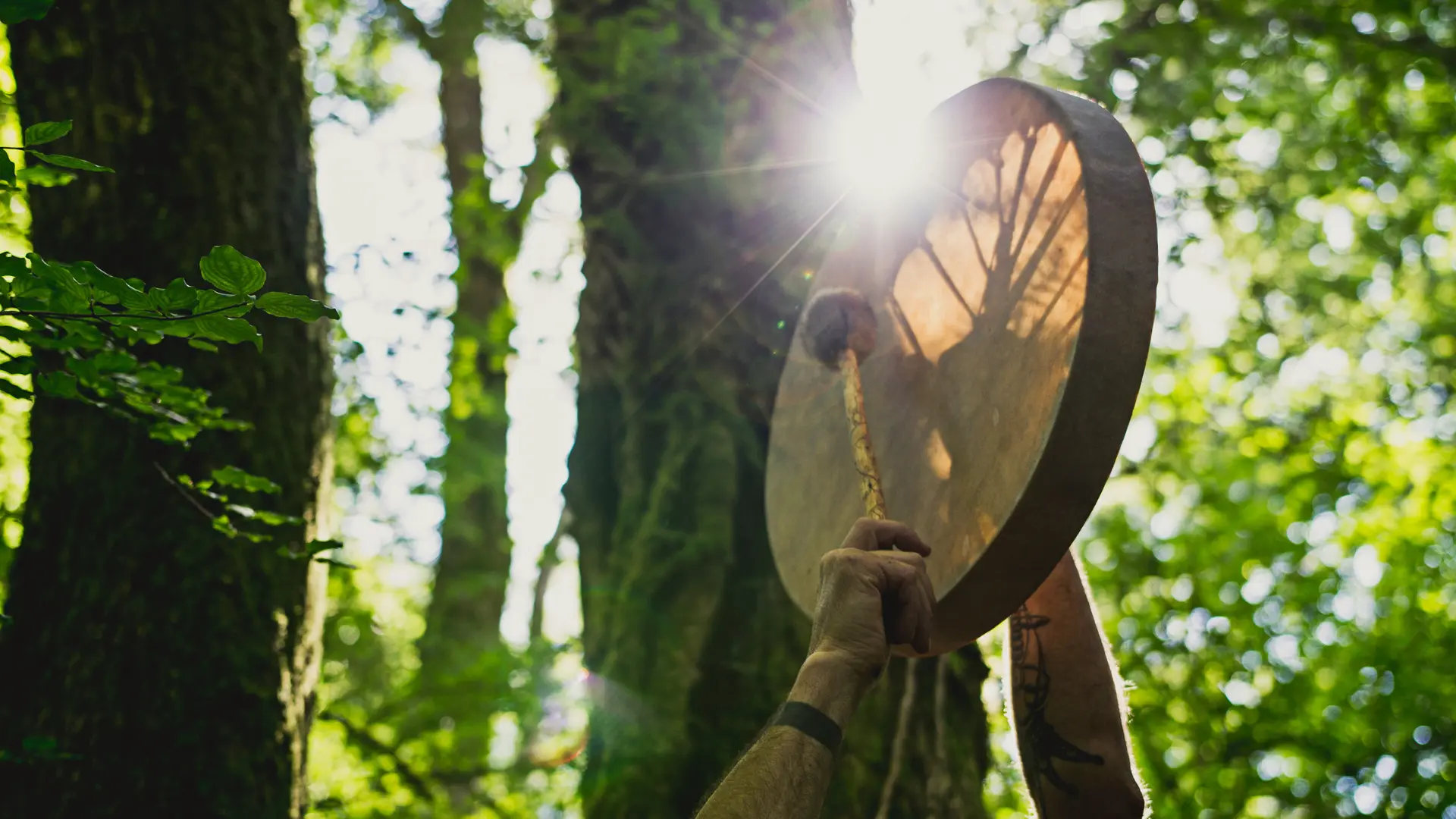
A shaman’s primary skill is the ability to intentionally enter an altered state of consciousness to travel into the spirit worlds. This is called the shamanic journey. This state is often induced by the monotonous, rhythmic sound of a drum or rattle. In specific geographical lineages, such as Amazonian or Mesoamerican traditions, this ecstatic state is alternatively or synergistically catalyzed through the ritualistic ingestion of entheogens (sacred plant medicines).
During the journey, the shaman partners with their own compassionate, helping spirits (such as their power animals and teachers) to diagnose the spiritual cause of the client’s problem and retrieve what is needed for their healing.
Causes of Illness (Shamanic Perspective)
In the shamanic view, illness and distress are often traced back to three main spiritual causes:
- Soul Loss: This is the most common cause. When we experience trauma (a car accident, abuse, a painful breakup, a difficult surgery), the shamanic belief is that a part of our vital life force, or soul, fragments and flees in order to survive the ordeal. This soul loss results in symptoms like depression, apathy, feeling “not all there,” chronic illness, or addiction.
- Spiritual Intrusions: These are blocks of misplaced energy that do not belong in a person’s body. They could be negative thoughtforms, astral larvae, or spirits, often from the environment or from other people (like an argument), that have become stuck in the client’s energy field. This can manifest as localized pain, illness, or outbursts of anger.
- Loss of Power: This is a disconnection from our spiritual allies. In the shamanic tradition, we are all born with a guardian spirit, often a power animal, that provides us with protection, wisdom, and vitality. A loss of this connection can leave a person feeling vulnerable, unlucky, and drained.
- Ancestral Entanglements: From a shamanic etiology, pathology is not strictly individualistic. Clients frequently carry intergenerational trauma—unresolved energetic imprints, karmic debts, or psychic contracts inherited from their ancestral lineage. These inherited densities manifest as chronic physiological ailments or repeating, destructive behavioral loops that require lineage-specific ceremonial clearing.
Common Shamanic Healing Techniques
Based on the spiritual diagnosis, the shaman and their guides will perform a specific healing.
- Soul Retrieval: This is the classic shamanic technique. The practitioner journeys (often to the Lower World) to find the lost soul part, compassionately convinces it to return, and “blows” it back into the client’s body, restoring their vitality.
- Extraction Healing: If a spiritual intrusion is found, the shaman works with their guides to “pull” this misplaced energy out of the client’s field and safely neutralize it.
- Power Animal Retrieval: The shamanic healer journeys to reconnect the power animal with the client, restoring their personal power and protection.
- Psychopomp: This is the practice of guiding spirits who are “stuck” in the Middle World (ghosts) to a place of peace, often done to clear a person’s home or energy field.
What a Shamanic Healing Session Looks Like
A client remains fully clothed, lying comfortably on a mat or massage table. The shaman will typically sit or stand beside them. The room is often darkened.
The majority of the session is conducted while the shaman is on their journey, which is audible as steady, rhythmic drumming or rattling. The practitioner may also shake a rattle over or around the client’s body, or gently blow on their chakras (crown, heart) to deliver the retrieved soul parts or remove intrusions.
Personally, I see shamanic healing as one of the deep roots of all energy medicine, but it differs from literal energy-based systems like Reiki. Even though both Reiki and shamanic healing can be performed at a distance, Reiki is typically considered a “passive” channeling of universal energy, while shamanic healing is an “active” practice of journeying, retrieving, and clearing. I have also integrated many shamanic principles into my own work, and use several of their healing techniques, as they provide an effective framework for restoring balance to the soul.