Reiki’s mechanism of action is understood via a holistic, spiritual framework that perceives the human being as a complete system of energy. The practice operates on principles distilled in the early 20th century by Mikao Usui, focusing on the restoration of natural harmony within the body’s subtle energetic system.
Principle of Channeling
The foundational principle of Reiki is channeling. A Reiki practitioner does not use their own personal Ki or life force; doing so would be draining and ineffective. Instead, through a process of attunement from a Reiki Master-Teacher, the practitioner’s own energy channels are opened and aligned, allowing them to act as a clear, passive conduit for Rei-Ki (spiritual energy). This energy is considered to possess its own innate intelligence. The practitioner simply places their hands and allows the energy to be drawn by the recipient’s body, flowing automatically to the areas where it is most needed to restore balance.
Diagnostic Process
Before treatment, practitioners often employ Byosen Reikan (scanning). By hovering hands over the recipient, the practitioner detects subtle Hibiki (sensations) such as heat, tingling, or coldness, which indicate areas of energetic accumulation or depletion. This sensory feedback loop guides the hands to locations requiring sustained transmission, ensuring the energy is delivered with precision rather than broad randomization.
Aura, Chakras, and the Hara
Reiki interacts with a person’s complete energetic anatomy, although different traditions emphasize different models.
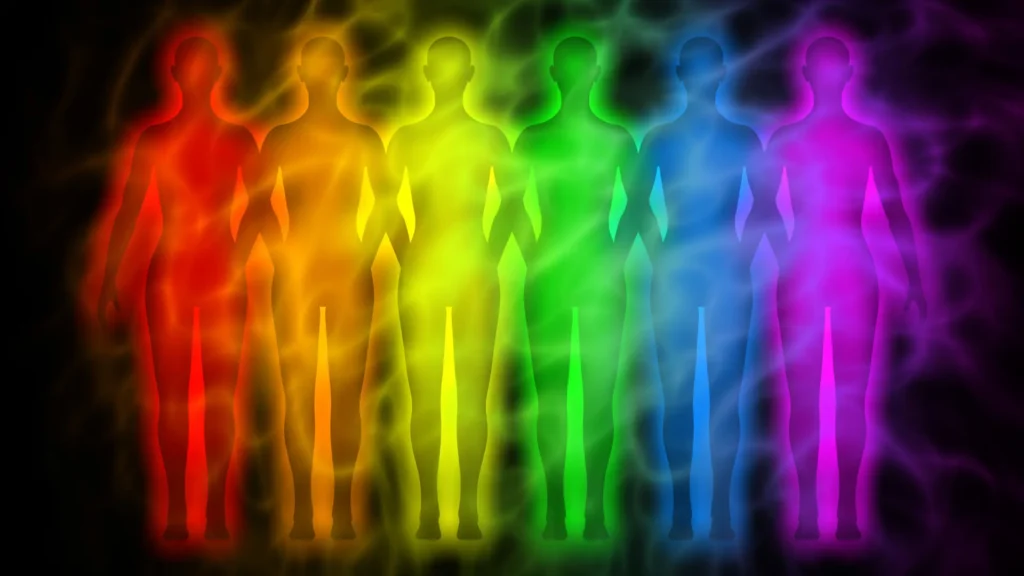
- Modern Western Reiki primarily focuses on the Aura (the biofield surrounding the body) and the seven Chakras (vortexes of energy that align with major endocrine glands and nerve plexuses). These are used as maps for hand placements and diagnosing imbalances.
- Traditional Japanese Reiki centers on the Hara, specifically the Seika Tanden located two to three inches below the navel. This area is considered the body’s vital battery and grounding point, essential for stability and accumulating Ki (life force energy).
Both systems share core concepts:
- Energy flows via pathways known as Keiraku (Meridians/Nadi).
- Imbalance is perceived as Byosen (stagnation or an unhealthy frequency) within this network.
Reiki practice aims to clear this stagnation, whether conceptualized as balancing the flow in the Hara system or restoring the energetic spin of the Chakras, thereby promoting a balanced systemic flow.
Three Degrees of Mastery
Reiki education (in traditional Usui Reiki Ryoho) is structured into three tiered levels of proficiency. Shoden (first degree) focuses on self-healing and physical hands-on treatment. Okuden (second degree) introduces symbols for mental-emotional balancing and distance work. Finally, Shinpiden (Master-Teacher) focuses on spiritual self-actualization and the mastery of Reiju (attunement rites), authorizing the initiate to transmit the lineage to others.
Role of the Healer
In the Reiki framework, the practitioner is not the “healer” but rather a facilitator of healing. Their primary role is to get their own ego and personality out of the way, maintain a state of meditative presence—often grounded in the Gokai (Five Precepts)—and become the clearest possible channel for the energy to flow through. The true healing is performed by the Reiki energy itself, in concert with the recipient’s own innate self-healing capacity. The special role of the Reiki Master-Teacher is to act as a guardian of the tradition’s lineage. They are not only practitioners but are also qualified to perform the sacred attunement rituals that open the channel for new students to learn and practice Reiki.
Symbols and Intent
While basic Reiki flows automatically, advanced efficacy is achieved through Okuden (second degree) techniques. The adept utilizes Shirushi (symbols) and Jumon (mantras) as energetic keys to modulate the vibrational frequency of the Ki. This is not forceful willing, but the application of specific archetypal signatures: Cho Ku Rei concentrates power, Sei He Ki addresses emotional strata, and Hon Sha Ze Sho Nen bridges time and space for non-local healing. These tools focus the practitioner’s intent, allowing the energy to penetrate specific psychological or physiological barriers more effectively.
Reiki Benefits
When the flow of Ki is restored and the energetic system is balanced, the body’s natural healing mechanisms are activated. This cascades into a variety of tangible benefits. The most immediate effect is a state of deep relaxation, which shifts the autonomic nervous system from sympathetic dominance to parasympathetic regulation. This process helps to relieve stress and chronic muscle tension. By clearing stagnant emotional energy from the aura and chakras, Reiki promotes emotional equilibrium and a sense of peace. The ultimate result is a greater feeling of mind-body balance, clarity, and overall well-being.