Meditation is the practice of consciously directing your awareness. It’s a fundamental human skill that allows you to guide your mind toward a specific outcome, whether that’s achieving deep stillness, cultivating boundless energy, or gaining profound insight into your own nature. While often associated with relaxation, meditation encompasses a vast landscape of mental techniques, each with a unique purpose and methodology. It’s less about following one rigid rule and more about using the inherent power of your focus to explore and train your consciousness.
Definition
At its core, meditation is the deliberate regulation of attention. This can take many forms. For some practices, the goal is to sustain focus on a single object, such as the breath or a mantra, to stabilize the mind. In others, the aim is to achieve a state of pure, thoughtless silence—a practice often described as “emptying the mind”. Still other forms, like introspection, actively use the mind to analyze thoughts, emotions, and beliefs to gain deeper self-understanding. The common thread isn’t the absence of thought, but the conscious, intentional engagement with your own awareness.
Origin and Etymology
The act of directing one’s mind is an inherent ability of any conscious being, arguably stretching back to the dawn of self-awareness. It’s not a practice that was invented in one place but a fundamental capacity of the mind itself. What history shows us are the various cultures that mastered, codified, and built sophisticated systems around this innate skill.
While the English word “meditation” derives from the Latin meditārī (“to ponder”), many of the most influential formalized systems originated in ancient India, documented in texts like the Vedas (c. 1500 BCE). Practices like Dhyāna (meditative absorption) within the yogic traditions are profound explorations of consciousness. However, these should be seen as highly developed methodologies for a universal human potential, not its sole point of origin.
Secular vs. Spiritual Contexts
Nowadays, meditation has bifurcated into two distinct streams, the spiritual path, and the secular path.
- The Spiritual Path: Rooted in Buddhism, Hinduism, and Taoism, this approach views meditation as a soteriological tool—a means to salvation, liberation (Moksha), or enlightenment (Nirvana). The context is often religious, involving ethics, rituals, and metaphysical beliefs.
- The Clinical & Secular Path: Popularized by figures like Jon Kabat-Zinn (MBSR), this approach extracts the technique from the dogma. Here, meditation is a form of mental hygiene and cognitive training aimed at stress reduction, performance enhancement, and psychological well-being, often devoid of spiritual goals.
Purpose
The purpose of meditation is as diverse as the techniques themselves. There’s no single goal; rather, the intention defines the practice. The aims can be broadly categorized:
- Relaxation and Stillness: Many practices are designed to calm the nervous system, reduce stress, and achieve deep states of physical and mental peace.
- Insight and Introspection: Some techniques use the focused mind as a tool for self-inquiry, analyzing patterns of thought and emotion to gain wisdom.
- Energy and Vitality: Certain methods, particularly those involving specific breathwork patterns (pranayama), are explicitly intended to boost mental alertness and physical energy.
- Spiritual Attainment: In many traditions, meditation is the primary path toward goals like enlightenment, self-realization, or a direct experience of a higher reality or the dissolution of the ego (ego-death).
Techniques
The vast number of meditation styles can be simplified into endless categories. Choosing a technique often depends on your personal goals. Here are a few examples of how various meditation practices can be categorized:
| Technique Category | Core Practice | Primary Goal | Examples |
|---|---|---|---|
| Focused Attention | Sustaining concentration on a single, chosen object (e.g., breath, mantra). | To develop mental stability and unwavering focus. | Samatha, Trataka, some forms of Zazen. |
| Observational | Watching the flow of thoughts, feelings, and sensations as they arise, often without judgment. | To develop insight, clarity, and emotional detachment. | Vipassanā (Mindfulness), Shikantaza. |
| Generative / Constructive | Actively cultivating specific thoughts, emotions, or visualizations. | To nurture positive psychological states and rewire emotional responses. | Metta (Loving-Kindness), Tonglen, Tantric Visualization. |
| Analytical | Using a focused state to actively investigate a specific topic, question, or personal belief. | To gain deep understanding and deconstruct mental patterns. | Analytical Meditation (Tibetan Buddhism), some forms of Self-Inquiry. |
| Energetic | Employing specific breathing techniques and visualizations to manipulate and increase vital energy. | To cultivate vitality, health, and heightened states of consciousness. | Pranayama, Qigong, Kundalini Meditation. |
The Physical Foundation
While meditation is a mental discipline, it relies heavily on physical architecture. The body acts as the vessel for the mind; if the vessel is unstable, the contents remain turbulent.
- Posture: Whether sitting on a cushion (Zafu), a chair, or the floor, the priority is an upright, self-supporting spine. This alertness prevents drowsiness while allowing the diaphragm to move freely for breath regulation.
- Stillness: Physical immobility acts as a dampener for sensory input. By voluntarily restricting movement, the brain ceases to process proprioceptive noise, freeing up resources for internal focus.
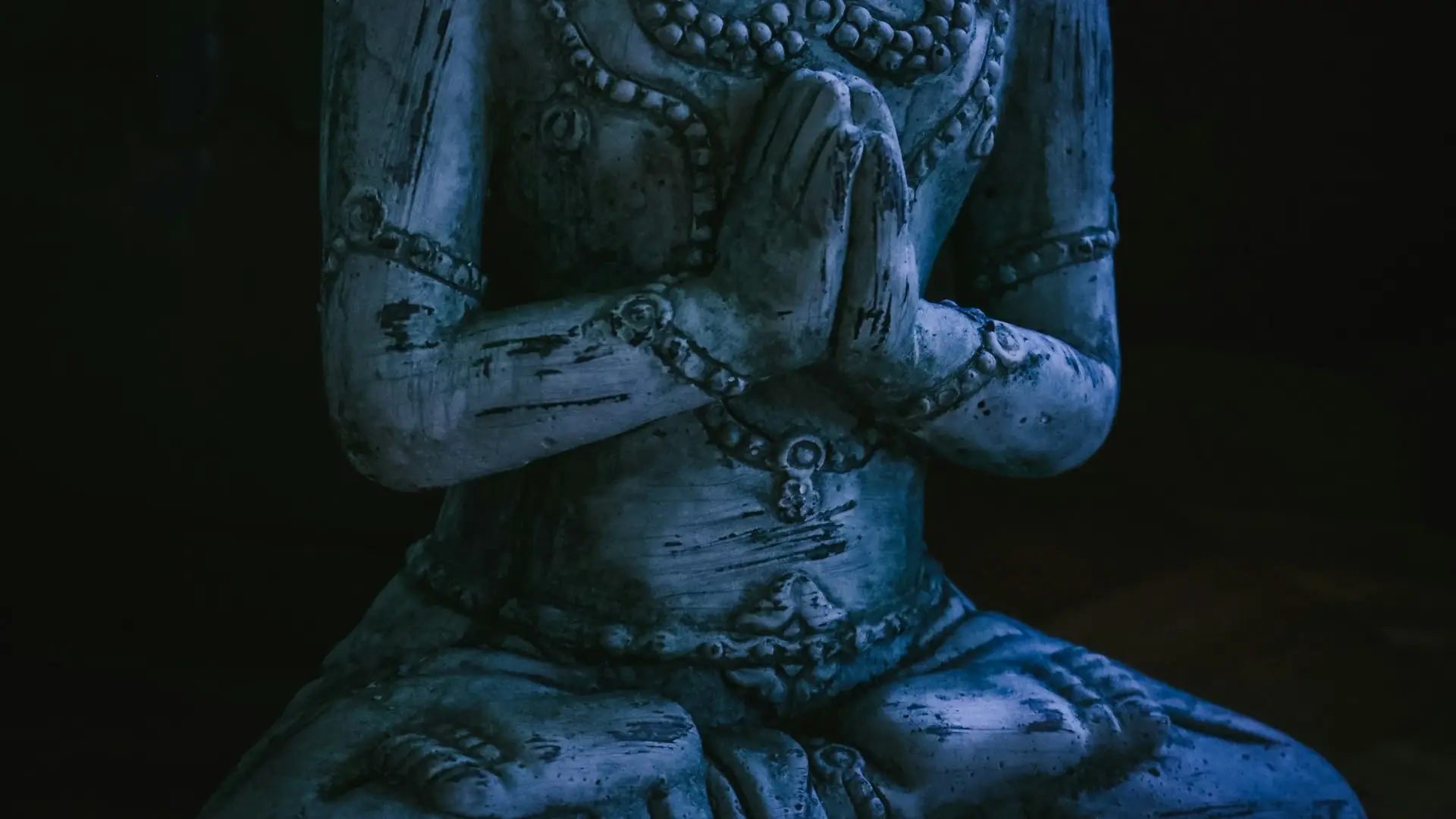
- Mudras: In many Eastern traditions, specific hand gestures (mudras) are used not merely for symbolism, but to create a “seal” that practitioners believe guides energy flow and locks in focus.
The Awareness Principle
The principle of awareness is central to all meditation, but how it’s used differs significantly. In many popular traditions, such as mindfulness, the key is developing non-judgmental awareness—the simple, impartial recognition of whatever is happening in the present moment. This cultivates acceptance and reduces reactivity. However, this is not a universal rule. In analytical and introspective practices, awareness is more discerning. It is actively used to probe, question, and evaluate experiences to separate truth from illusion. Here, the distinction between the ‘observer’ (consciousness) and the ‘observed’ (thoughts) becomes the focal point.. In this context, awareness is less of a passive observer and more of an active instrument of investigation.
The Role of Focus and Attention
Regardless of the technique, focus is the engine of meditation. It is the skill of directing and sustaining your attention. Think of attention as a flashlight beam that you learn to control. In focused-attention meditation, you learn to hold that beam steady on one spot. In observational or analytical meditation, you learn to sweep the beam across your inner landscape, illuminating whatever comes into view. The initial and ongoing challenge of practice is training this flashlight—noticing when it has wandered off and gently but firmly bringing it back. This repetitive training is what strengthens your “attentional muscle,” which in turn empowers every other aspect of the practice.
Benefits
Consistent meditation practice is safe and leads to a wide spectrum of benefits, many of which are now being mapped and validated by neuroscience. These changes are largely driven by neuroplasticity, the brain’s remarkable ability to rewire itself based on repeated experience. The specific benefits can vary depending on the type of practice, but generally fall into several key domains:
- Psychological and Emotional: Almost all forms of practice can lead to reduced stress and anxiety by improving emotional regulation. Techniques that cultivate compassion can increase positive emotions and social connectivity, while analytical techniques can resolve long-standing psychological conflicts.
- Cognitive: Training your attention directly enhances your ability to focus, resist distractions, and hold information in your working memory. Your thinking can become clearer, sharper, and more flexible.
- Physical: The profound mind-body link means mental training has physical effects. Different practices can lead to lower blood pressure, improved sleep, a more robust immune response, and a change in the perception of pain. Energizing practices can directly increase physical vitality.